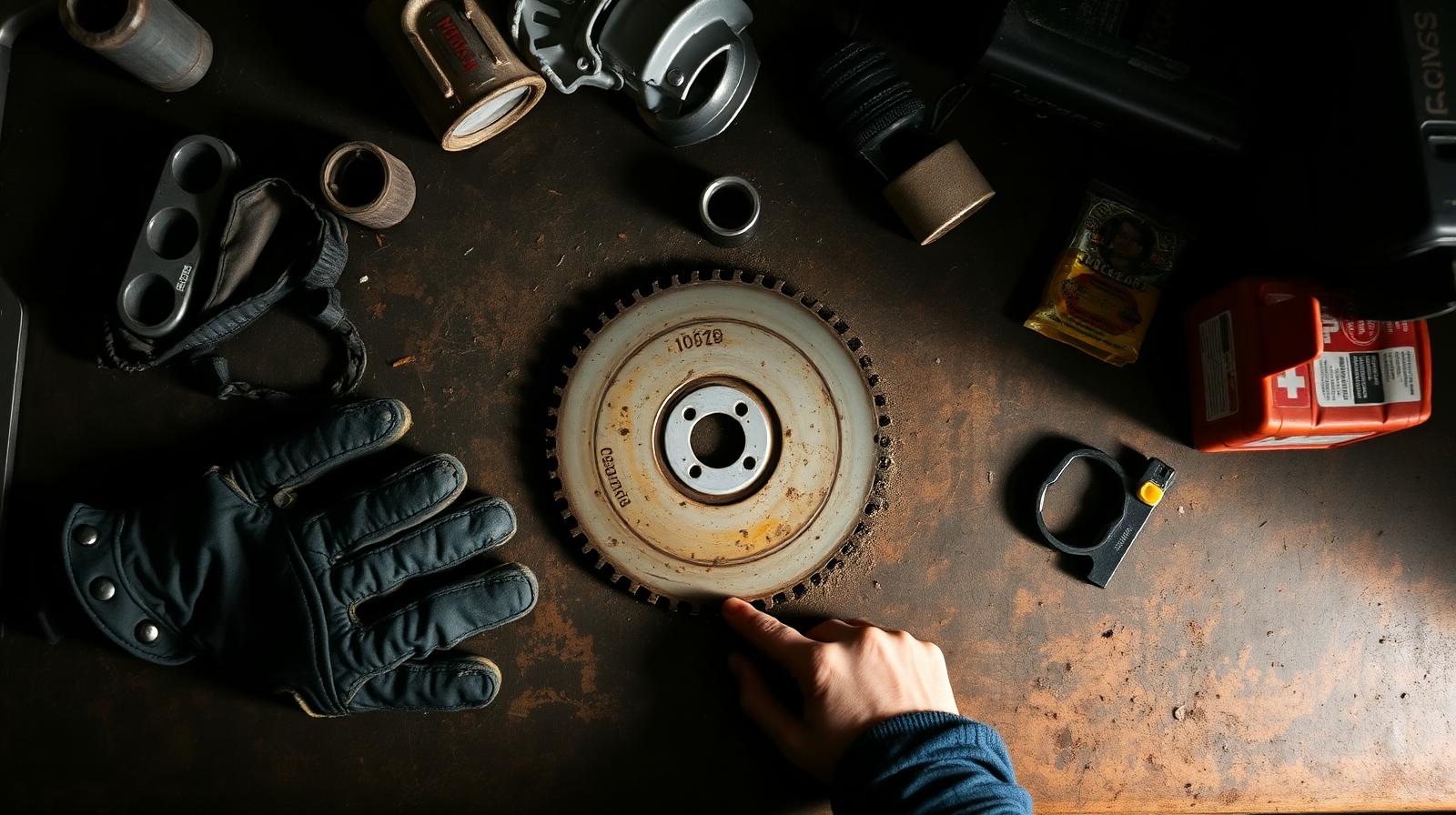
Mower Blade Injuries: The Hidden Cost of Removing Your Blade
Ask ten people what causes mower injuries and ten of them will say "you stuck your hand under it while it was running." Some do. Most don't.
The American Academy of Orthopaedic Surgeons reports more than 80,000 lawn-mower injuries treated in U.S. emergency rooms every year, including roughly 9,000 to children. The U.S. Consumer Product Safety Commission has tracked similar figures for years across its National Electronic Injury Surveillance System. The category that gets the least attention in those numbers is the one this post is about: lacerations and crush injuries from blade removal, sharpening, and reinstallation.
Why blade maintenance is dangerous
A mower blade is a 22-inch piece of hardened steel weighing 1.5–2 lbs, sharpened on both ends, with a torque-spec bolt holding it onto a vertical shaft. To sharpen it the conventional way you have to:
- Tip the mower on its side.
- Wedge something into the deck to lock the blade.
- Break loose a bolt that's been on for two years, often using a breaker bar.
- Catch the blade as it drops free.
- Carry a freshly-sharpened, double-edged piece of metal back to the deck.
- Re-torque the bolt without slipping.
Every step on that list has a documented injury pattern. The most common in the literature:
- Hand lacerations during the break-loose step, when the wrench slips and the hand drives forward into the blade edge.
- Crushed fingers when the blade drops free unexpectedly during reinstallation.
- Eye injuries from flying debris when sharpening on a bench grinder or angle grinder without a face shield.
- Burns from grabbing a blade still hot from grinding.
- Back injuries from tipping heavier self-propelled mowers without help.
The CDC's National Institute for Occupational Safety and Health has run multiple workplace-safety briefings on landscape maintenance equipment for the same reason — even pros, with training and PPE, get hurt doing this work.
The fuel-line and battery side
For gas mowers there's a separate failure mode: people forget to disconnect the spark-plug wire. The blade can rotate the engine just enough to fire a cylinder, and the blade snaps around 60–120 degrees. That's enough travel to break a wrist or take a finger. The U.S. Consumer Product Safety Commission's safety alerts include cases like this every year.
For electric mowers the equivalent failure is leaving the battery installed or the safety key engaged. A bumped trigger with the blade in your hand is a very bad day.
The blade-bolt torture story
One of the case studies that circulated in the small-engine repair community a few years ago was a homeowner who didn't fully retorque his blade bolt after sharpening. He'd done it dozens of times. This time, mid-mow at full RPM, the bolt walked loose, the blade departed the spindle, exited the side discharge, and went through the side of his neighbor's vinyl-sided garage. Nobody was hurt — but the failure mode is exactly the kind of thing that does hurt people. Underdone torque on a 3,000-RPM rotating mass is not a small mistake.
This is why the entire blade-removal workflow is a risk-stacking exercise. Every step adds a way to get hurt or to do the job wrong.
The product-company version of "stop doing this"
We're not in the lawn-care injury statistics business. We're in the "make this not happen" business. The whole reason The Core exists is to delete steps 1, 3, 4, 5, and 6 from the conventional sharpening workflow. You don't tip the mower more than a few degrees. You don't remove the blade. You don't carry a sharpened blade across your garage. You don't touch the bolt at all.
A reciprocating saw with a sharpening attachment is also inherently safer than a bench grinder or angle grinder. The cutting tool is captive in your hand, the abrasive doesn't throw a wheel of sparks at your face, and the blade you're sharpening doesn't have to be balanced because you never took it off.
For why this matters beyond the immediate safety case, the full breakdown of cost-to-the-mower is in our pillar piece: How a sharp mower blade extends the life of your electric mower (and your battery).
The shortest safety guidance we can give
If you're sharpening the traditional way, the AAOS lawn-mower safety page is the canonical primer. The non-negotiables:
- Disconnect the power source. Spark-plug wire on gas, battery and safety key on electric. Every single time.
- Heavy gloves rated for cut resistance. Not work gloves. Cut-resistant gloves, Level A4 or above.
- Eye protection and a face shield for any grinding work.
- Wedge the blade, don't trust your grip. A piece of 2x4 in the deck is non-negotiable.
- Torque the bolt to spec on reinstall. Look it up in the manual. Don't guess.
Or do it our way and skip the whole thing in 60 seconds with the blade still bolted on.
— The 60 Seconds Sharp team. More Field Notes · Read the pillar on electric-mower longevity